AI Dependency Is Growing: Are We Losing the Ability to Think for Ourselves?
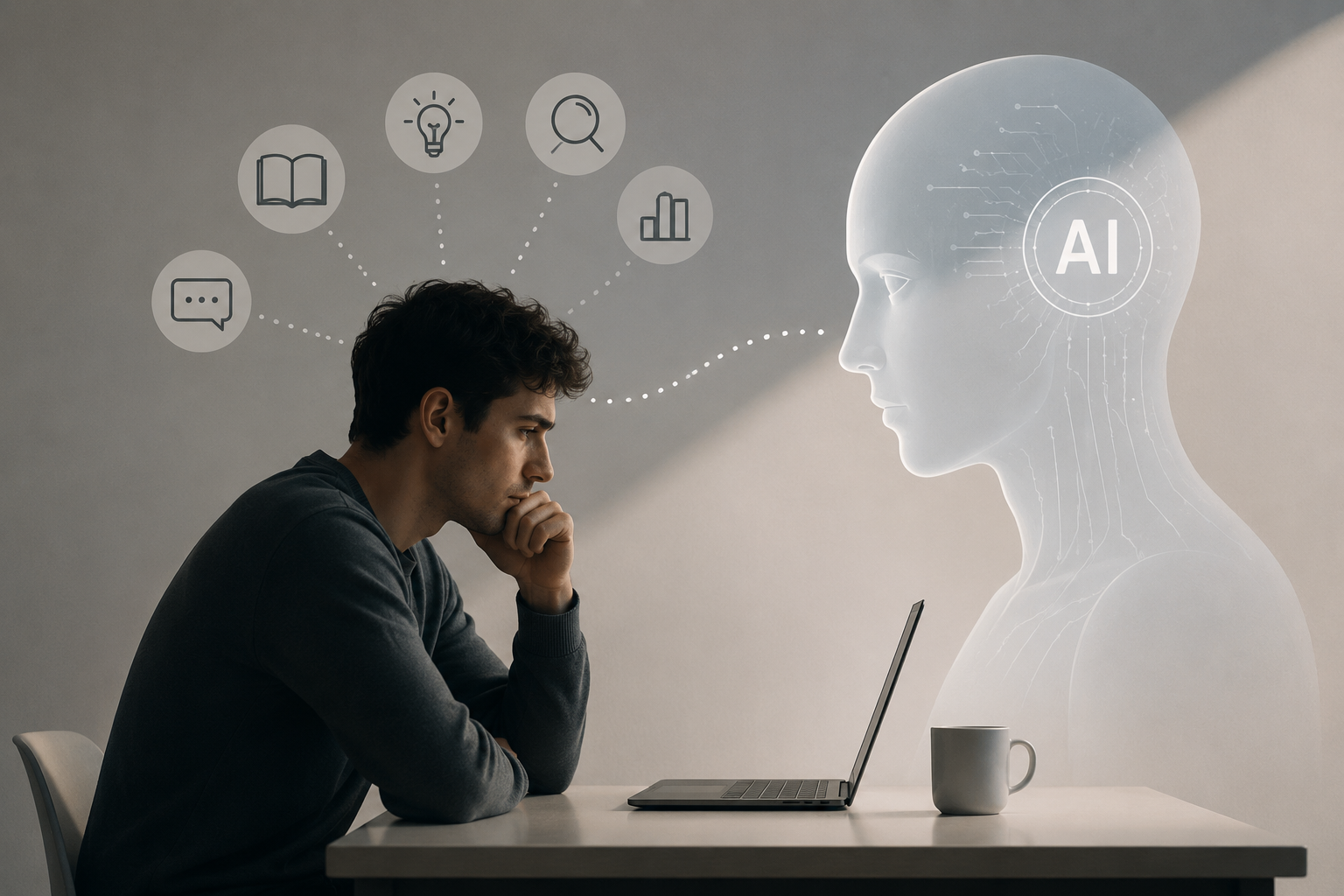
How AI Dependency Is Changing Human Thinking
AI dependency is becoming one of the most important conversations of the digital age.
A few years ago, artificial intelligence was mainly a tool for automation. Today, it helps people write emails, answer questions, plan trips, summarize books, make business decisions, and even provide emotional support.
Many people now turn to AI before consulting a friend, searching a website, or thinking through a problem themselves.
This raises an important question:
Are we using AI as a helpful tool, or are we slowly outsourcing our thinking to machines?
The answer is not simple. AI offers incredible convenience, but it also challenges how humans learn, think, and make decisions.
What Is AI Dependency?
“AI dependency” refers to a growing reliance on artificial intelligence for tasks that traditionally required human judgment, memory, creativity, or critical thinking.
Examples include:
- Using AI to write messages and emails
- Asking AI to summarize information
- Relying on AI recommendations for decisions
- Using AI tools for studying and research
- Seeking advice from AI assistants
While these tools save time, excessive dependence can reduce opportunities to develop independent thinking skills.
Why AI Dependency Is Growing So Quickly
Convenience Is Hard to Resist
AI can provide answers in seconds.
Instead of spending time researching multiple sources, users receive quick summaries and recommendations.
For busy professionals and students, this convenience is extremely attractive.
Information Overload
People are exposed to more information than ever before.
AI helps filter, organize, and simplify complex information, making it easier to process.
Personalized Assistance
Modern AI systems can adapt to user preferences and behavior.
This creates experiences that feel personal, efficient, and highly relevant.
How AI Is Changing the Way We Think
From Searching to Asking
Traditionally, people searched for information and evaluated multiple sources.
Today, many users simply ask AI for an answer.
This shift changes how information is consumed and processed.
Memory Is Becoming External
People increasingly rely on smartphones, cloud services, and AI systems to remember information.
Dates, contacts, notes, and even ideas are often stored digitally rather than mentally.
Faster Answers, Less Reflection
Quick responses can be useful, but they may reduce the time spent questioning, analyzing, and exploring different perspectives.
Critical thinking often develops through struggle, not instant solutions.
The Benefits of AI Dependency
Not all AI dependence is negative.
When used wisely, AI can significantly improve productivity and learning.
Increased Efficiency
AI helps users:
- Save time
- Automate repetitive tasks
- Organize information
- Improve workflows
Better Accessibility
AI tools make information more accessible to people with different educational backgrounds and abilities.
Enhanced Learning
Students can use AI to:
- Understand difficult concepts
- Practice new skills
- Explore unfamiliar topics
Used correctly, AI can act as a learning partner rather than a replacement for thinking.
The Hidden Risks of AI Dependency
Reduced Critical Thinking
If users accept every AI-generated response without verification, they may become less likely to question information.
Overconfidence in AI
Artificial intelligence can make mistakes.
Even advanced systems occasionally generate inaccurate or incomplete information.
Creativity May Suffer
Creative thinking often emerges from experimentation, uncertainty, and problem-solving.
Over-reliance on AI-generated ideas may reduce opportunities for original thought.
Decision-Making Risks
When people allow AI to make increasingly important decisions, they may lose confidence in their own judgment.
AI Dependency and Everyday Life
The influence of AI is becoming visible across daily activities.
People use AI to:
- Choose what to watch
- Decide what to buy
- Plan schedules
- Write content
- Learn new skills
- Manage relationships
As AI becomes more integrated into everyday experiences, understanding its influence becomes increasingly important.
How to Use AI Without Losing Independent Thinking
1. Treat AI as a Tool, Not an Authority
AI should assist your thinking, not replace it.
Always remain actively involved in the decision-making process.
2. Verify Important Information
Cross-check facts using trusted sources before accepting them as accurate.
3. Ask Follow-Up Questions
Instead of accepting the first answer, challenge assumptions and explore alternative viewpoints.
4. Continue Learning Independently
Read books, conduct research, and develop skills without relying entirely on AI-generated summaries.
5. Practice Critical Thinking
Ask yourself:
- Is this information accurate?
- What evidence supports this claim?
- Are there alternative perspectives?
Why This Debate Matters for the Future
As artificial intelligence becomes more powerful, society will face an important challenge:
How do we benefit from AI without weakening human judgment?
The goal should not be to reject AI.
The goal should be to develop a healthy relationship with technology where AI enhances human intelligence rather than replacing it.
For research and insights on responsible AI development, explore the resources available from the Partnership on AI.
Conclusion
AI dependency is growing because artificial intelligence offers something people naturally value: convenience.
The ability to receive instant answers, personalized recommendations, and automated assistance is transforming how we work and learn.
However, convenience comes with responsibility.
The more capable AI becomes, the more important it is to protect critical thinking, creativity, and independent judgment.
Technology should expand human potential, not replace it.
The future may belong to those who learn how to work with AI while still thinking for themselves.
Suggested Readings:
AI Memory: The Feature That Could Change How We Use Technology Forever
Is AI Going to Replace Google Search? https://rategears.com/is-ai-going-to-replace-google-search-what-users-are-choosing-in-2026/
The Attention War: Why Every App Is Fighting for Your Mind
Why More People Are Using AI as a Personal Therapist
Are Algorithms Deciding What You Believe?
ai-dependency-outsourcing-thinking-to-ai





Post Comment