Are We Living in a Digital Maya? How Technology Shapes Reality
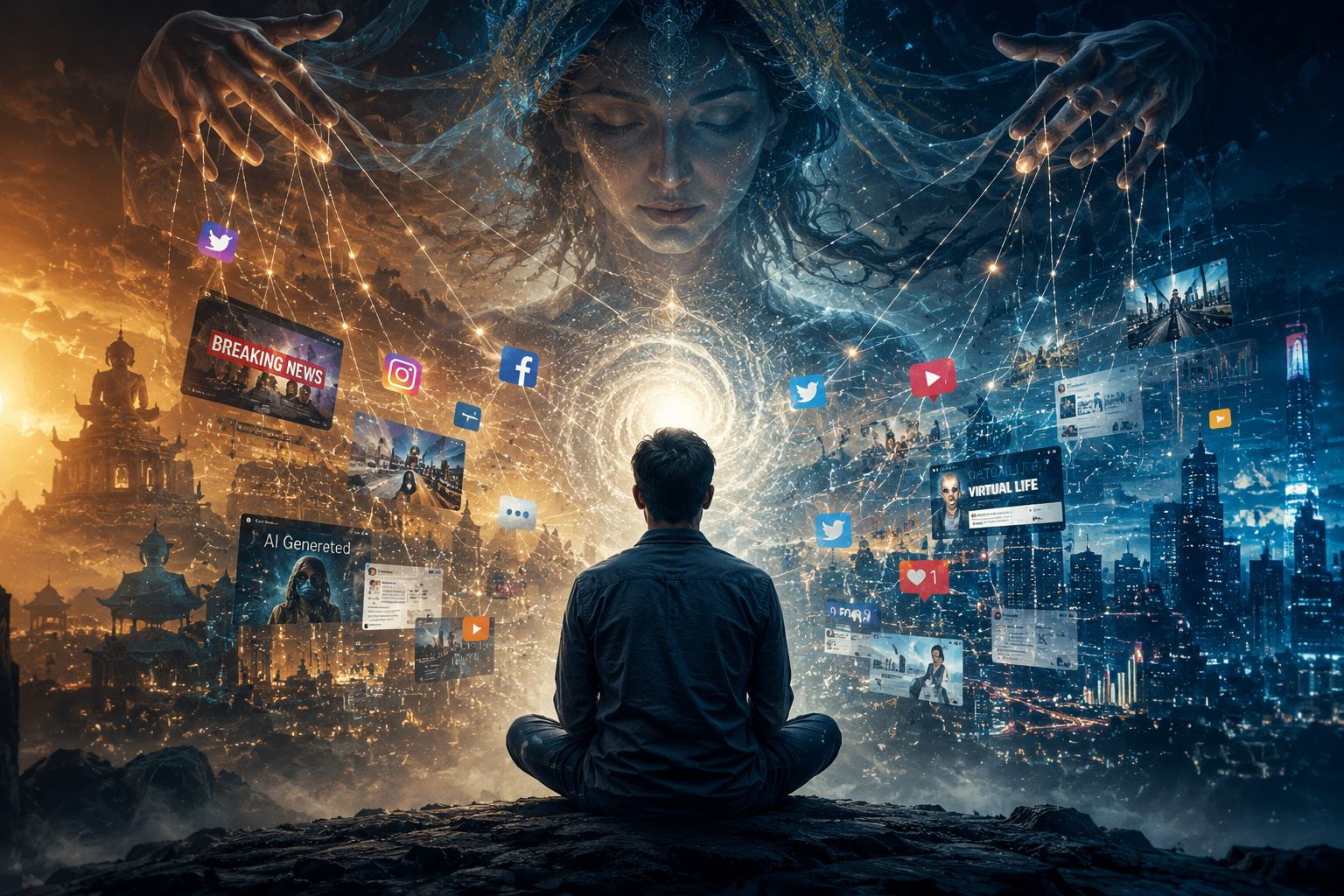
Are we living in a digital Maya? Discover how social media, AI, algorithms, and misinformation shape our perception of reality and what ancient wisdom can teach us in 2026.
Introduction
Every day, billions of people wake up and immediately check their phones.
We scroll through social media feeds, watch videos, read news headlines, and interact with artificial intelligence tools. Much of what we believe about the world comes through screens.
But what if the reality we experience online is not the complete picture?
This question is surprisingly similar to a concept found in the Yoga Vasistha and other Indian philosophical traditions: maya.
Traditionally, Maya refers to the illusion that prevents us from seeing reality clearly. In today’s digital world, technology can sometimes create a modern version of this illusion.
This raises an important question:
Are we living in a digital Maya?
What Is Maya?
In Indian philosophy, Maya is often described as the power that makes the temporary appear permanent and the unreal appear real.
It does not necessarily mean that the world is fake. Instead, it suggests that our perception can be incomplete, distorted, or influenced by external factors.
The Yoga Vasistha repeatedly teaches that the mind plays a major role in shaping our experience of reality.
Today, technology has become one of the strongest influences on how people perceive the world.
How Technology Shapes Reality
Technology is not just a tool anymore.
It influences:
- What we see
- What we believe
- What we buy
- Who we trust
- How we think
Most online experiences are controlled by algorithms designed to keep users engaged.
As a result, different people can experience completely different versions of reality online.
The Role of Social Media Algorithms
Why Algorithms Matter
Social media platforms decide which content appears in your feed.
These algorithms often prioritize:
- Emotional content
- Viral posts
- Controversial topics
- Content that increases engagement
The result is that users may repeatedly see information that confirms their existing beliefs.
This is often called an echo chamber.
How Echo Chambers Create Digital Maya
When people only see viewpoints similar to their own, they may begin to believe that everyone thinks the same way.
Over time:
- Different opinions disappear.
- Confirmation bias grows.
- Perception becomes narrower.
- Reality becomes distorted.
This is one way technology can create a digital Maya.
Artificial Intelligence and the Illusion of Truth
Artificial intelligence is becoming a major source of information.
Many people now use AI tools to:
- Research topics
- Summarize information
- Generate content
- Answer questions
AI can be incredibly useful.
However, AI systems can sometimes:
- Generate inaccurate information
- Present opinions as facts
- Reflect biases from training data
- Create convincing but incorrect answers
This does not make AI harmful, but it highlights the importance of critical thinking.
External Resource:
https://www.ibm.com/topics/artificial-intelligence
Deepfakes and Digital Reality
One of the biggest challenges in 2026 is the rise of deepfake technology.
AI can now create:
- Fake videos
- Synthetic voices
- Artificial images
- Realistic digital identities
Sometimes it becomes difficult to distinguish between authentic and generated content.
This creates new questions:
- What can we trust?
- How do we verify information?
- How do we separate reality from manipulation?
These concerns make digital literacy more important than ever.
Why the Human Mind Is Vulnerable
Technology alone does not create illusion.
Human psychology also plays a role.
People naturally tend to:
- Seek information that supports existing beliefs
- Avoid uncomfortable facts
- Follow popular opinions
- React emotionally to content
Modern platforms are designed around these tendencies.
As a result, misinformation can spread faster than the truth.
What Yoga Vasistha Can Teach Us
The Yoga Vasistha emphasizes a powerful concept called “Viveka,” or discernment.
Discernment means learning to question appearances before accepting them as truth.
In the digital age, Viveka can help us:
- Verify information before sharing it
- Question sensational headlines
- Recognize manipulation
- Think independently
- Develop balanced perspectives
Ancient wisdom remains surprisingly relevant in a world dominated by algorithms.
How to Escape Digital Maya
1. Verify Information
Always check multiple reliable sources before accepting claims.
2. Limit Algorithm Dependence
Avoid relying on a single platform for information.
3. Practice Digital Awareness
Pay attention to how content influences your emotions and opinions.
4. Seek Diverse Perspectives
Read viewpoints that challenge your assumptions.
5. Develop Critical Thinking
Ask questions instead of immediately accepting information as true.
Frequently Asked Questions
What is Digital Maya?
“Digital Maya” refers to the modern illusion created by technology, algorithms, misinformation, and online experiences that can distort our perception of reality.
How does social media shape reality?
Social media algorithms determine what content users see, influencing opinions, beliefs, and perceptions.
Is artificial intelligence creating digital Maya?
AI can contribute to Digital Maya when users blindly trust generated content without verification.
How can we avoid misinformation online?
Fact-check information, consult multiple sources, and develop strong critical thinking habits.
Conclusion
Technology has transformed how humans experience reality.
From social media algorithms to artificial intelligence and deepfakes, digital tools increasingly influence what people see, think, and believe.
The concept of Maya in the Yoga Vasistha offers a powerful lens for understanding these challenges.
The solution is not to reject technology.
Instead, it is to use technology with awareness, discernment, and critical thinking.
In an age of information overload, the ability to see clearly may become one of the most valuable skills of all.
Related Reading
Interested in the future of AI technology?
Is AI Going to Replace Google Search? What Users Are Choosing in 2026
https://rategears.com/is-ai-going-to-replace-google-search-what-users-are-choosing-in-2026/
Why Search Engines Are Becoming Answer Engines in 2026
https://rategears.com/why-search-engines-are-becoming-answer-engines-in-2026/
Why More People Are Switching to Browser-Based Tools Instead of Installing Software
https://rategears.com/why-more-people-are-switching-to-browser-based-tools-instead-of-installing-software/
AI Agent or AI Chatbot: What Do You Need in 2026?
https://rategears.com/ai-agent-or-ai-chatbot-what-do-you-need-in-2026/




Post Comment