AI Wearables in 2026: The Gadgets Becoming Your Second Brain
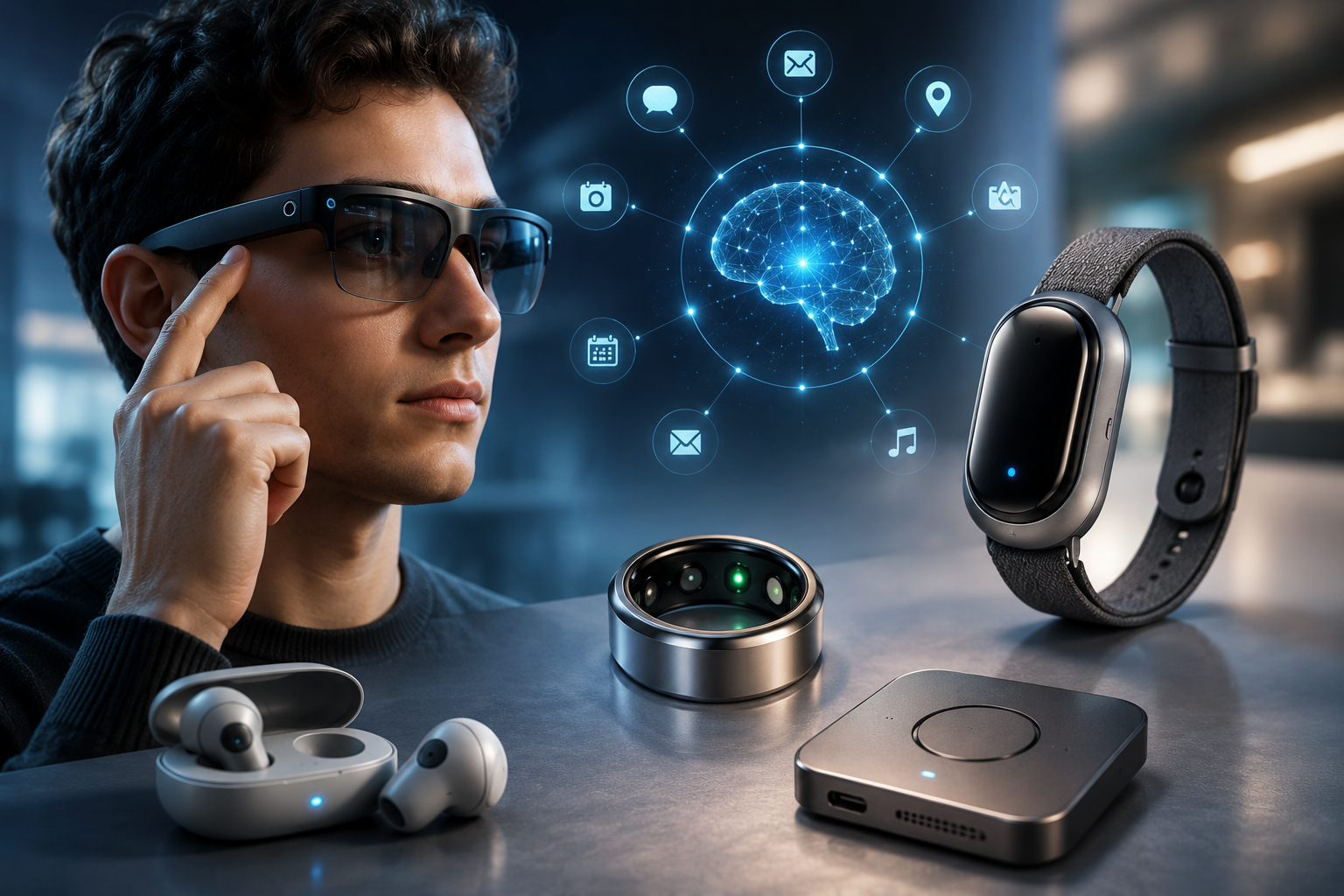
For years, smartphones have been the center of our digital lives.
We use them to communicate, search for information, manage schedules, track health, and capture memories.
But in 2026, a new generation of technology is beginning to change that.
Instead of pulling a phone from your pocket every few minutes, AI-powered wearable devices are bringing intelligence directly into everyday life.
From AI rings and smart glasses to wearable assistants and note-taking devices, these tools are becoming much more than gadgets.
They are becoming a second brain.
What Are AI Wearables?
AI wearables are devices that combine wearable technology with artificial intelligence.
Unlike traditional gadgets that simply collect data, AI wearables can understand information, learn user behavior, and provide personalized assistance.
Examples include:
- AI-powered smart glasses
- AI rings
- Wearable AI assistants
- AI note-taking devices
- Health-monitoring wearables
The goal is simple:
Make technology feel less like a tool and more like an intelligent companion.
Why AI Wearables Are Growing So Fast
Several factors are driving the popularity of AI wearables.
People Want Faster Access to Information
Smartphones require users to stop what they are doing.
Wearables reduce this friction.
Information becomes available instantly through voice commands, visual displays, or automatic suggestions.
AI Has Become More Powerful
Modern AI models can:
- Understand conversations
- Summarize information
- Translate languages
- Manage tasks
- Answer questions
This makes wearable devices significantly more useful than earlier generations.
Consumers Want Less Screen Time
Many people are experiencing digital fatigue.
AI wearables offer a way to stay connected without constantly staring at a screen.
AI Smart Glasses Are Making a Comeback
One of the most exciting developments in 2026 is the rise of AI smart glasses.
Unlike earlier attempts, modern smart glasses focus on practical everyday assistance.
They can:
- Display navigation directions
- Translate conversations in real time
- Identify objects and landmarks
- Provide reminders
- Answer questions using AI
Instead of looking down at a phone, users receive information naturally through their field of vision.
Why Smart Glasses Matter
Smart glasses bring technology closer to human behavior.
People naturally look at the world around them.
The device simply adds useful information when needed.
External Resource: https://www.techradar.com
AI Rings: Small Devices With Big Capabilities
AI rings are becoming increasingly popular because they are discreet and easy to wear.
Unlike smartwatches, rings require very little interaction.
AI rings can monitor:
- Quality of Sleep
- Heart rate
- Stress levels
- Recovery metrics
- Daily activity
Some newer devices use AI to analyze patterns and provide personalized health recommendations.
The appeal is simplicity.
Users gain valuable insights without constantly checking a screen.
Wearable Assistants Are Becoming Personal Helpers
Imagine having an assistant available throughout the day.
That is the promise of wearable AI assistants.
These devices can:
- Schedule meetings
- Create reminders
- Summarize conversations
- Answer questions
- Manage daily tasks
Instead of opening multiple apps, users can interact through voice commands.
The result is a more seamless experience.
The Rise of AI Note-Taking Devices
Note-taking technology is one of the fastest-growing categories of AI wearables.
Many professionals fail to capture ideas, meetings, and conversations effectively.
AI-powered note-taking devices solve this problem by:
- Recording discussions
- Generating summaries
- Organizing information
- Creating action items
For students, professionals, and entrepreneurs, this can significantly improve productivity.
Who Benefits Most?
AI note-taking devices are especially useful for:
- Students
- Journalists
- Researchers
- Consultants
- Business professionals
Rather than worrying about remembering every detail, users can focus on the conversation itself.
How AI Wearables Are Changing Everyday Life
AI wearables are slowly making their way into daily routines.
Health and Wellness
Wearables track health data and deliver tailored insights.
Users understand better sleep, recovery, fitness, and stress.
Productivity
AI helpers help with scheduling and reducing mental load.
Learning
Students can access information, summaries, and explanations more quickly.
Travel
Smart glasses can provide navigation and language translation without requiring a phone.
The Benefits of AI Wearables
Convenience
Information is available when needed.
Personalization
AI learns user preferences and adapts accordingly.
Improved Productivity
Tasks become easier to organize and manage.
Reduced Screen Dependency
Many interactions happen without opening a smartphone.
The Challenges and Concerns
Despite the benefits, AI wearables also raise important questions.
Privacy
Many devices collect large amounts of personal data.
Users should understand how information is stored and used.
Security
As devices become more connected, protecting personal information becomes increasingly important.
Overdependence
Some experts worry that excessive reliance on AI could reduce independent thinking.
Technology should support human decision-making, not replace it.
Are AI Wearables Really Becoming a Second Brain?
In many ways, yes.
AI wearables are increasingly helping people:
- Remember information
- Manage tasks
- Monitor health
- Access knowledge instantly
They are not replacing human intelligence, though.
Instead, they are improving it.
The most successful users will likely be those who use AI as a tool rather than as a replacement for thought.
What the Future Looks Like
The next few years will likely bring even more advanced AI wearables.
Future devices may:
- Understand emotions
- Provide proactive recommendations
- Offer real-time coaching
- Integrate seamlessly into daily life
Technology companies are racing to create devices that feel invisible yet incredibly useful.
The goal is not simply smarter gadgets.
The goal is to create technology that works naturally alongside humans.
Frequently Asked Questions
What are AI Wearables?
AI wearables are wearable devices that use artificial intelligence to provide personalized assistance, health tracking, productivity tools, and real-time information.
Are AI wearables replacing smartphones?
Not yet. However, many experts believe AI wearables may reduce dependence on smartphones by enabling faster, more natural interactions.
What are examples of AI wearables?
Examples include AI smart glasses, AI rings, wearable assistants, smart earbuds, and AI-powered note-taking devices.
Are AI wearables safe?
Most AI wearables are safe when used properly, but users should carefully review privacy policies and security settings before sharing personal data.
Who can benefit from AI wearables?
Students, professionals, travelers, fitness enthusiasts, and anyone looking to improve productivity or health monitoring can benefit from AI wearables.
Final Thoughts
AI wearables are one of the biggest technology trends in 2026.
Whether it be smart glasses, AI rings, wearable assistants, or note-taking devices, these tools are revolutionizing the way people interact with technology.
The biggest change is not the hardware itself.
It is the relationship of man with technology.
Instead of reaching for a device, people are starting to wear intelligence all day.
This is why AI wearables are often referred to as a second brain.
Whether they become the next smartphone or just a powerful companion, one thing is for sure:
The future of computing is more personal, more intelligent, and more wearable.
Related Reading
Can AI Replace Google Search? What Users Are Choosing in 2026
https://rategears.com/is-ai-going-to-replace-google-search-what-users-are-choosing-in-2026
Digital Stimulation: What Happens When Your Brain Is Never Alone?
Everyone Is a Brand Now: The New Reality of the Internet
External Resources
TechRadar Wearable Technology:
https://www.techradar.com
MIT Technology Review:
https://www.technologyreview.com
Wired Technology:
https://www.wired.com





Post Comment