How Media Reinforces Falsehoods: Understanding the Digital Mind in 2026
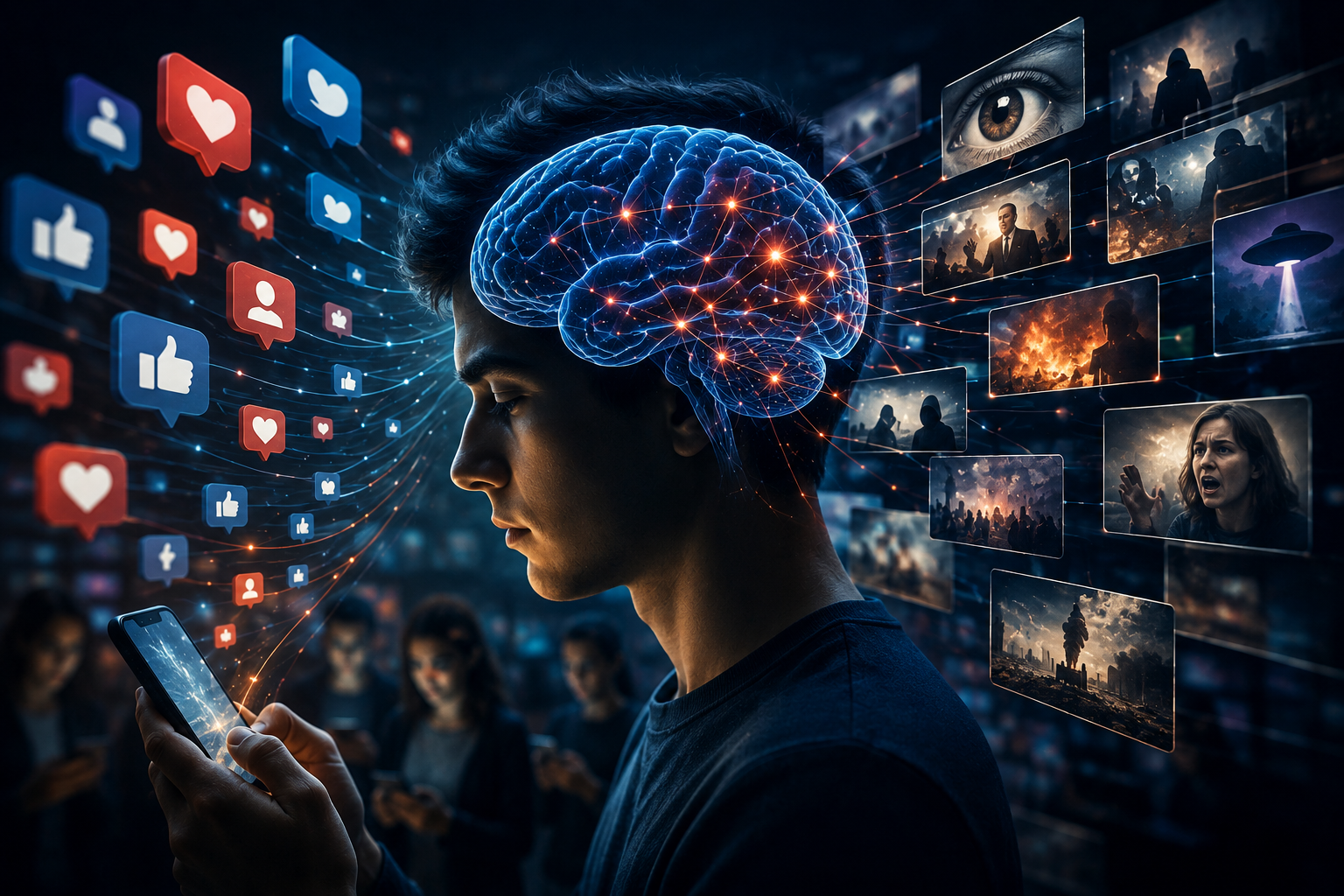
How does media reinforce falsehoods? Discover how social media algorithms, misinformation, and digital echo chambers shape beliefs and influence what we think is true in 2026.
Every day, billions of people scroll through social media, watch videos, read headlines, and consume information online.
Most of us believe we are simply receiving information.
But what if the information we see is carefully selected by algorithms designed to maximize engagement?
This is where the concept of the digital mind becomes important.
In 2026, one of the biggest challenges facing society is understanding how media reinforces falsehoods and shapes our perception of reality.
What Is the Digital Mind?
The digital mind is the way our thoughts, opinions, and beliefs are increasingly shaped by digital platforms.
Today much of what we know comes from the following:
- Social media feeds
- Search engines
- News websites
- AI-generated content
- Video recommendations
These systems affect not only our vision but also our beliefs.
How the Media Reinforces Falsehoods
Some false information is not spread by people who are deliberately lying.
“There are a lot of lies and conspiracy theories that get amplified because online platforms reward attention and engagement.
Research shows that engagement-driven systems can exacerbate misinformation and ideological polarization.
1. Algorithms are engagement-driven.
Social media platforms are designed to keep people engaged.
Content that triggers
- Curiosity
- Fear of
- Anger
- Surprise
often gets more clicks, shares, and comments.
Consequently, sensational content can outpace factual information in terms of spread.
2. Repetition Creates Familiarity
The more often people see a claim, the more likely they are to believe it.
Even when information is inaccurate, repeated exposure can make it feel familiar and trustworthy.
This is one reason misinformation can become difficult to challenge.
3. Echo Chambers Strengthen Beliefs
Social media algorithms often show users content similar to what they already engage with.
Over time, people may be exposed primarily to opinions that match their existing views.
This creates what researchers call echo chambers.
Why Misinformation Spreads So Easily
There are many reasons why people spread false information online.
Emotional Content Goes Viral Faster
People are likely to share content that triggers strong emotions.
Other examples are:
- Outrage
- Fear
- Excitement
- Shock
Research suggests emotionally charged misinformation can spread rapidly through social networks.
AI Makes Content Creation Easier
In 2026, AI can generate:
- Articles
- Images
- Videos
- Voice recordings
While these tools offer benefits, they can also be used to create convincing false content.
Information Overload
People are consuming more information than ever.
This makes it more difficult to verify every claim before sharing it.
Signs You May Be Trapped in an Information Bubble
Ask yourself:
- Do I only follow sources that agree with me?
- Do I fact-check before sharing content?
- Am I exposed to different viewpoints?
- Do headlines influence my opinion before I read the article?
If the answer is “yes” to some of these questions, you may be experiencing algorithmic filtering.
How to Think Critically in the AI Era
The solution is not to avoid technology.
The solution is to use it more consciously.
Practical Tips
- Cross-check information from different sources.
- Read beyond headlines.
- Check original sources whenever possible.
- Be cautious of emotionally charged content.
- Question information that perfectly confirms your beliefs.
Critical thinking is turning into one of the most valuable skills in the digital age.
What Does This Mean For The Future
As AI and algorithms become more powerful, it will become increasingly important to understand how media reinforces falsehoods.
The problem is not access to information anymore.
The difficulty is to find information that is trustworthy.
Technology can help us learn faster than we ever could.
But it can also lie faster than ever before.
Frequently Asked Questions
How does media reinforce falsehoods?
Media reinforces false beliefs when algorithms repeatedly expose users to misleading information, emotionally charged content, or one-sided viewpoints.
What is an echo chamber?
Echo chamber: An environment in which people are exposed primarily to information that confirms their beliefs.
Why is misinformation a growing problem?
The combination of social media, AI-generated content, and engagement-driven algorithms allows false information to spread quickly online.
Conclusion
The digital world has changed how we learn, communicate, and form opinions.
It’s no longer just a media literacy issue to understand how media propagates falsehoods. It’s a critical life skill.
In an era of AI-generated content, viral misinformation, and algorithmic feeds, the ability to ask questions, verify facts, and think critically may be more valuable than ever.
Further reading:
Interested in the future of AI technology?
What Happens When Your AI Knows More About You Than Google Does?
https://rategears.com/what-happens-when-your-ai-knows-more-about-you-than-google-does/
Why Search Engines Are Becoming Answer Engines in 2026
https://rategears.com/why-search-engines-are-becoming-answer-engines-in-2026/
AI Agent or AI Chatbot: What Do You Need in 2026?
https://rategears.com/ai-agent-or-ai-chatbot-what-do-you-need-in-2026/
The Death of Passwords? Why Passkeys Are Becoming the New Standard in 2026
What Happens When Your AI Knows More About You Than Google Does?
World Health Organization – Understanding misinformation:
https://www.who.int
Google Fact Check Explorer:
https://toolbox.google.com/factcheck/explorer



Post Comment