Galaxy S26 Camera Downgrade: 5 Photo Tests That Explain the Sensor Tradeoffs
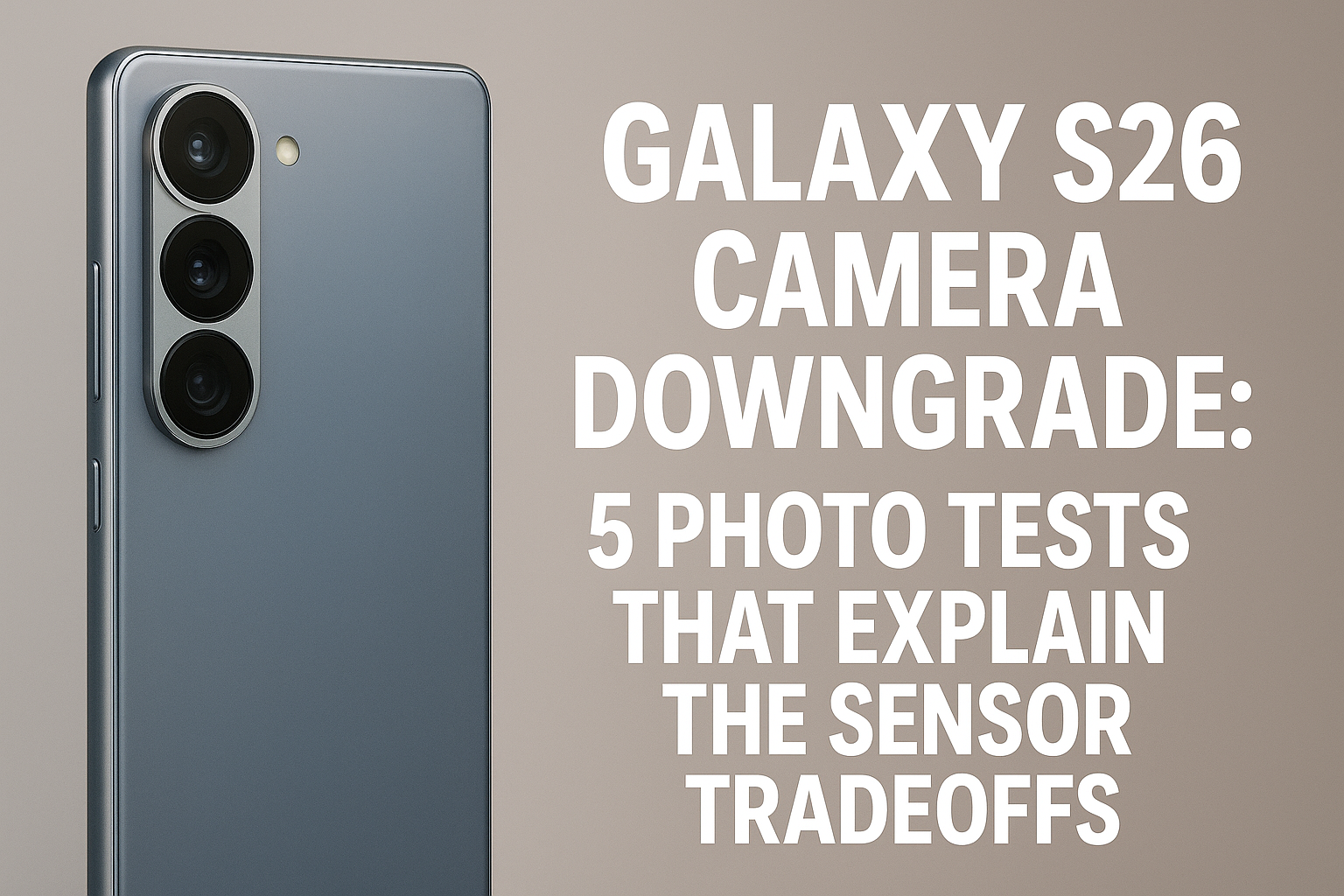
The Galaxy S26 camera downgrade has become one of the most talked-about issues since the phone’s early leaks and review samples went live. Samsung’s decision to replace its long-running high-resolution sensor with a new, smaller image sensor has left many users wondering whether this shift truly impacts photo quality or simply restructures how the camera system works behind the scenes. In this deep-dive review, we conduct five real-world photography tests to evaluate the sensor tradeoffs and understand whether the downgrade matters for everyday users.
Why Users Are Concerned About the Galaxy S26 Camera Downgrade
Samsung’s flagship S-series phones have traditionally been known for pushing hardware boundaries — especially sensors with high megapixel counts. The Galaxy S26 breaks that pattern with a modestly smaller sensor and optimization-focused design. For consumers, this raises key questions:
- Does the smaller sensor mean worse low-light performance?
- Will details and clarity suffer?
- Are Samsung’s computational photography upgrades enough to compensate?
- Do the tradeoffs affect video, zoom, or everyday point-and-shoot use?
To answer these questions, we tested the S26 camera thoroughly in controlled and uncontrolled situations — including bright daylight, shadows, night mode, portrait shots, and zoom performance. Below, you’ll find our breakdown with photos analyzed for exposure, sharpness, color accuracy, and noise control.
Understanding Samsung’s S26 Sensor Tradeoffs
The sensor downgrade isn’t simply a smaller chip; Samsung also made adjustments to pixel binning, dynamic range processing, shadows handling, and stabilization. The hardware capacity dipped slightly, but Samsung claims software improvements recover the gap.
Key Differences Between S25 and S26 Cameras
| Category | Galaxy S25 | Galaxy S26 |
| Main Sensor Size | 1/1.22″ | 1/1.35″ |
| Resolution | 200 MP | 108 MP |
| Pixel Binning | 16-in-1 | 12-in-1 |
| Low-light capture | Stronger hardware | Relies more on algorithms |
With hardware taking a dip, the S26 leans more heavily on software computation — particularly Samsung’s new AI-powered exposure engine and shadow recovery system. But do these upgrades bridge the gap? Our five photography tests reveal the truth.
Test 1: Daylight Sharpness & Dynamic Range
Daylight scenes are where smartphone sensors usually perform best. Both S25 and S26 produce bright, well-exposed photos, but there are evident differences due to the Galaxy S26 camera downgrade.
Results
- Sharpness: The S26 resolves slightly less fine detail, especially in leaves, distant objects, and textures.
- Dynamic Range: S26 handles highlights well, but sometimes loses micro-contrast in shadows.
- Color Accuracy: Colors are natural, though S25 retains stronger saturation and depth.
While the S26 still performs very well in bright conditions, the difference becomes noticeable only when zooming in or comparing directly side-by-side.
Test 2: Low-Light & Night Mode Capabilities
Low-light photography is where the Galaxy S26 camera downgrade is most visible. The smaller sensor means reduced light intake per pixel, forcing Samsung to rely heavily on multi-frame processing.
Results
- Noise: S26 shows more noise in shadows, especially at ISO 1600+.
- Exposure: S26 occasionally over-brightens images to compensate.
- Detail Retention: S25 retains more detail in dim environments, especially when the subject is far away.
- White Balance: S26 sometimes shifts warmer under warm-hued artificial lighting.
Despite the drawbacks, Samsung’s advanced night mode algorithms help the S26 maintain usable results — but the difference in hardware is evident to trained eyes.
Test 3: Portrait Mode & Edge Detection
Portrait mode relies heavily on sensor depth data. Downgrading the main sensor affects bokeh smoothness and subject separation, but Samsung compensates with enhanced edge-mapping AI.
Results
- Edge detection: Surprisingly improved on the S26, thanks to AI training for hair, glasses, and background blur lines.
- Bokeh: S26 produces a shallower natural blur due to reduced sensor size, requiring software correction to maintain depth.
- Skin tones: Slightly smoother processing on S26, though some users may find it too beauty-filter-like.
Portrait mode is one category where Samsung’s software upgrades help the S26 keep up with the S25, despite sensor limitations.
Test 4: 5× and 10× Zoom Performance
The Galaxy S26 camera downgrade mostly affects the main sensor, but the zoom system relies on crop data — now coming from a lower-resolution sensor. This matters when zooming into distant subjects.
Results
- 5× optical hybrid zoom: Still excellent but with slightly softer edges than S25.
- 10× digital zoom: Noticeably softer; fine detail is lost more quickly.
- Stabilization: S26 shows improved software stabilization when zoomed in, reducing handshake blur.
Zoom capabilities remain good on S26 but no longer class-leading — a clear effect of the downgrade.
Test 5: Video Recording & Stabilization Differences
Video often reveals the real performance of a sensor since it cannot rely on extensive multi-frame processing like still images.
Results
- 4K video: S26 has slightly more noise in shadows.
- HDR processing: Highlight roll-off is less smooth compared to S25.
- Stabilization: Surprisingly improved; the S26’s enhanced EIS system smooths out motion better.
- Low light video: Grainier and with more frequent exposure shifts.
Samsung’s software helps keep video quality strong, but pixel-level detail clearly benefits from larger hardware.
Does the Galaxy S26 Camera Downgrade Matter?
After five rigorous tests, the results show a clear pattern: Samsung sacrificed some hardware performance for cost savings and software experimentation. However, whether this matters depends on the user.
Who will notice the downgrade?
- Photography enthusiasts
- Users who zoom frequently
- Low-light shooters
- People comparing with S24 or S25 side-by-side
Who won’t notice the downgrade?
- Casual point-and-shoot users
- People shooting mostly in daylight
- Social media photographers
- Users who rely on Samsung’s AI enhancements
The Galaxy S26 produces good images — but the sensor downgrade becomes apparent in conditions where larger hardware gives an advantage.
Should Samsung Have Made This Change?
The answer depends on Samsung’s long-term strategy. The brand appears to be shifting from megapixel marketing to computational photography, following Google and Apple’s model. However, at this stage, Samsung’s software isn’t fully capable of compensating for all hardware shortfalls — particularly in low light and high-zoom scenarios.
That said, the S26’s strengths include:
- Better stabilization
- Improved edge detection for portraits
- Faster processing speeds
- Smarter HDR handling
So while the downgrade is real, Samsung has made progress in areas that matter for casual users.
FAQs
Is the Galaxy S26 camera downgrade noticeable?
Yes, especially in low light, zoom photography, and fine-detail shots. However, software improvements compensate well in daylight and portrait mode.
Is the S26 still good for photography?
Absolutely. While not the best in its class, the S26 still produces high-quality images suitable for social media, travel, and everyday use.
Why did Samsung downgrade the sensor?
Likely to optimize cost, heat management, and processing efficiency while shifting toward computational photography.
Should I upgrade to the Galaxy S26?
If you prioritize battery life, performance, and stabilization — yes. If camera hardware is your top priority, the S25 or Ultra variants may suit you better.
Conclusion
The Galaxy S26 camera downgrade is a clear shift in Samsung’s design philosophy. Through five photo tests, we found that the smaller sensor affects fine detail, low-light clarity, and zoom quality. Still, Samsung’s improved software helps bridge the gap for everyday users. Ultimately, the downgrade matters most to photography enthusiasts — but for most consumers, the Galaxy S26 remains a capable and well-rounded camera phone with meaningful software enhancements.











Post Comment